How to annotate a book: a simple system that works
A light, practical way to annotate books on paper or a Kindle: what to mark, which few symbols to use and how to make notes you will return to.
· 3 min read
In short
- Annotating is a conversation with the book: mark what matters, and say briefly why.
- A few consistent marks, such as an underline, a line in the margin, a question mark and a star, are easier to read later than a rainbow of colours.
- A short index inside the cover, or a line at the end of each chapter, turns annotations into something you can find again.
On this page (8)
Some readers wouldn't dream of writing in a book. Others can't read without a pencil. If you are in between, or would like to start, this is a simple way to annotate that doesn't slow your reading down and leaves you with something useful when you close the book.
Why annotate at all
In his 1940 essay How to Mark a Book, the philosopher Mortimer Adler argued that you only truly own a book once you have made it part of yourself, and that writing in it is how you do that. Marking forces you to decide what matters as you read, and the act of deciding keeps your attention on the page.
Annotations also make a book findable. Months later, a glance at your marks tells you what you thought, where the best passages are and what you disagreed with, without reading the whole thing again.
What you need
A pencil. It is soft on the page, it doesn't bleed through and it can be erased if you change your mind. Some readers add a few sticky tabs to mark pages they want to return to. On a Kindle, highlights and notes do the same job, and there is a section on that below.
What to mark
- The sentence that carries an argument, not the paragraph around it.
- Ideas that surprise you or change your mind.
- Definitions and terms you will want to look up again.
- Passages you disagree with, which are often the most interesting later.
- Places that remind you of another book, a person or your own work.
If you are marking more than a few passages per chapter, you are probably marking out of habit. The fewer marks, the more each one says.
A small set of symbols
Pick five or six marks and stick to them across all your books. For example:
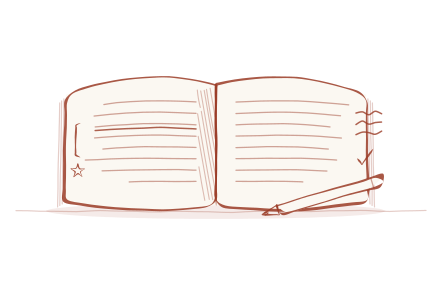
- Underline: an important sentence.
- A line in the margin: an important passage, too long to underline.
- A star: one of the best passages in the book.
- A question mark: unclear, doubtful or wrong.
- An arrow: connects to something else, with a word on what.
- A circled word: to look up.
Writing in the margins
Marks show where; words in the margin say why. Keep them short: a question, a counterargument, a name, a page number of a related passage. At the end of a chapter, a single sentence summing it up in your own words is one of the most useful annotations you can make.
Readers have written in their books for as long as there have been books, and some of their notes became famous. We tell that story in a short history of marginalia.
Make an index inside the cover
Use the blank pages at the front or back of the book for your own index: a keyword and a page number for every passage you starred or want to find again. It takes seconds per entry, and it turns the book into a reference you can use without leafing through it.
Annotating on a Kindle
A Kindle has no margins, but highlights and notes cover most of the same ground. Highlight the sentence, add a short note with your reaction, and use your shorthand inside the note: “?” for doubt, “→” followed by a word for a connection. The notebook then collects all of them in order, which is a ready-made index. Our guide to taking notes on a Kindle covers the details.
After the last page
When you finish, leaf through your marks once. Pick the passages that still matter and copy them somewhere of your own, the way readers have done for centuries in a commonplace book. It takes a quarter of an hour, and it is the moment the book becomes yours.