Marginalia: a short history of writing in the margins
From medieval glosses to Fermat's famous note, readers have always written in their books. A short history of marginalia, and why it still matters.
· 3 min read
In short
- Marginalia are the notes, marks and drawings readers leave in the margins of books.
- Medieval scholars wrote glosses, Renaissance readers drew little pointing hands, and Pierre de Fermat left the most famous margin note in mathematics.
- Digital highlights and notes are today's marginalia, and like the old ones, they are worth returning to.
On this page (7)
Open an old library book and you may find them: a pencilled exclamation mark, an underline, a word of protest in a stranger's hand. Readers have always written in their books. For centuries it wasn't considered vandalism but good reading, and some of those notes have become as famous as the books they were written in.
What marginalia are
The word comes from the Latin margo, edge or border. Marginalia are everything a reader adds to the edges of a page: notes, questions, corrections, cross-references, underlines and brackets, small drawings. They are a record of a reader thinking, left in the place where the thinking happened.
Glosses and commentaries
In medieval manuscripts, explanations were often written right onto the page, between the lines or around the main text. These glosses grew over generations until some texts sat in the middle of the page like an island, surrounded by commentary. The standard glossed Bible of the Middle Ages, the Glossa Ordinaria, was read that way for centuries: the text and its readers' notes, inseparable.
Pointing hands and other marks
Medieval and Renaissance readers had a favourite mark for an important passage: a small drawn hand with a pointing index finger, known as a manicule. Some were a few quick strokes, others had cuffs, rings and elaborate sleeves. Readers also wrote nota, “note this”, beside passages worth remembering, much as we underline today.
The most famous margin note
Around 1637, the French mathematician Pierre de Fermat was reading an edition of the ancient Greek Arithmetica of Diophantus. Next to one problem he noted that he had found a truly marvellous proof of a related claim, which the margin was too narrow to contain.
The proof was never found. The claim, known as Fermat's Last Theorem, occupied mathematicians for more than 350 years, until Andrew Wiles proved it in the 1990s. Few notes have given anyone that much to think about.
Writers in the margins
The poet Samuel Taylor Coleridge annotated his own books and his friends' so freely that his marginalia fill several volumes of his collected works. His friend Charles Lamb joked that the books Coleridge borrowed came back richer for his notes. Edgar Allan Poe published a series of short pieces under the title Marginalia. Many writers since have left libraries full of arguments with the authors they read.
Those notes are why scholars hunt for annotated copies: a book with its owner's marks shows not only what they read, but how.
Why many of us stopped
Libraries, schoolbooks that had to be passed on and the idea of books as objects to keep pristine taught generations of readers to leave the margins blank. It is a loss. A clean book records nothing of the person who read it. If you would like to start writing in yours again, our guide on how to annotate a book suggests a simple way.
Digital marginalia
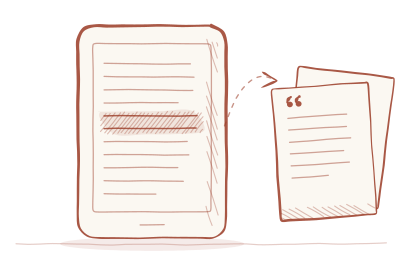
Every highlight and note on a Kindle is marginalia by another name: a reader marking a passage and talking back to it. What is missing is the margin itself. The notes no longer sit on the page where you will stumble over them years later; they disappear into a notebook few people ever open.