The commonplace book: an old habit for keeping what you read
For centuries, readers copied the best passages into a notebook of their own. What a commonplace book is, who kept one, and how to start yours.
· 4 min read

In short
- A commonplace book is a personal collection of passages worth keeping, copied from what you read, often with your own thoughts beside them.
- Readers kept them from antiquity through the Renaissance and long after. Erasmus taught the method to students, and John Locke published a way to index one.
- Starting one takes little: a notebook or a file, the habit of copying what strikes you with its source, and a way to find it again.
On this page (6)
Long before highlighters and e-readers, readers who came across a sentence worth keeping did something that now sounds laborious: they copied it out by hand, into a notebook kept for that purpose. Over a lifetime these notebooks grew into a record of everything that had mattered to their owner on the page.
The habit has a name, the commonplace book, and it is having a quiet revival among readers who feel that highlighting alone isn't enough. Here is what it is, where it comes from and how to start one.
What is a commonplace book?
A commonplace book is a notebook, or today often a file, in which you collect passages from your reading: sentences you admire, arguments you want to remember, facts, lines of poetry. Most keepers add their own thoughts beside them, and many sort the entries by subject.
The name comes from the Latin loci communes, “common places”: the general headings, such as friendship, courage or time, under which a passage could be filed and found again. It isn't a diary, which is about your days, nor a reading log, which lists what you read. It is about what you found in your reading and decided to keep.
A short history of the commonplace book
The idea is ancient. In one of his letters, the Roman philosopher Seneca advised reading the way bees gather nectar: collecting from many flowers, then blending what you gathered into something of your own. Medieval scholars compiled florilegia, literally “gatherings of flowers”, collections of extracts from authorities they wanted at hand.
In the Renaissance the commonplace book became a standard tool of education. Erasmus, in his 1512 handbook on style De Copia, told students to keep a notebook organised under headings and to fill it with whatever they read that was worth remembering. Generations of schoolboys learned to read this way, pen in hand.
In 1686 the philosopher John Locke published a method for indexing a commonplace book so that any entry could be found again quickly; it appeared in English in 1706 as A New Method of Making Common-Place-Books. Thomas Jefferson kept a literary commonplace book as a young man, copying out passages of poetry and prose that stayed with him. Many writers and scientists since have kept notebooks of the same kind, whatever they called them, and others wrote straight into their books instead, as we tell in a short history of marginalia.
Why copying passages works
Copying a passage slows you down. You read it again, closely, word by word, and you decide that it deserves the effort. That decision, and the minute spent on it, is why a copied passage stays with you in a way a highlighted one rarely does.
A commonplace book also gathers your reading in one place. Passages from different books start to talk to each other: a novelist and a philosopher saying the same thing in different words, an idea you met three times without noticing. And because you return to the book, you meet your passages again, which is what memory needs. We go into the research in how to remember what you read.
How to start a commonplace book
- Choose a medium you will actually use. A paper notebook is slower and therefore more deliberate. A document or notes app is searchable and always at hand. Either works; switching between them every month doesn't.
- Copy only what strikes you. A sentence that changed your mind, a description you envy, a fact you want to be able to quote correctly. If you hesitate, leave it out.
- Always note the source. Author, book and page or location. Future you will want to find the context, or quote it properly.
- Add a line of your own. Why it matters, what it reminds you of, where you disagree. This is what turns a collection of quotes into your book.
- Give entries a few headings. Locke's index was a system of letters and page numbers; today a few keywords or tags do the job. Keep the list of headings short so you reuse them.
A commonplace book for Kindle readers
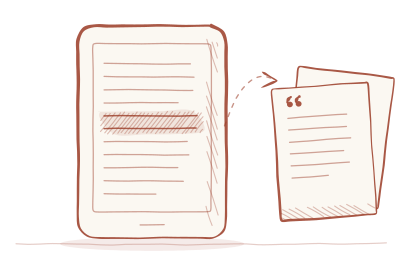
If you read on a Kindle, you already do half of the work. Every highlight is a passage you once thought worth keeping, a first draft of a commonplace book. What is missing is the second step: choosing, copying, adding your own words.
One way is to export your Kindle highlights and go through them book by book. Another is to let them come back to you over time and copy over the ones that still move you on the second encounter. That second reading is a natural filter: what still resonates months later belongs in the book.
Keeping it going
The best commonplace books are not the most complete, they are the ones that were kept. Keep it close to where you read, make entries short, and once in a while read your own book from the start. You will find a portrait of yourself as a reader, written in other people's sentences.