Spaced repetition for readers: remember books without flashcards
Spaced repetition is one of the most reliable ways to remember. How readers can use it for books without turning every chapter into flashcards.
· 3 min read
In short
- Spaced repetition means coming back to something at growing intervals, just as it starts to fade.
- It was developed for facts and flashcards, but the principle works for books: return to your best passages after days, weeks and months.
- Highlights make good review material, as long as there are few of them and they come back at a gentle pace.
On this page (7)
Language learners and medical students swear by it: review a fact just before you would forget it, and every review makes it last longer. Spaced repetition is one of the best-supported ideas in memory research. Most readers have never used it for books, because flashcards and novels don't mix. They don't have to.
What spaced repetition is
Since Hermann Ebbinghaus's experiments in the 1880s, psychologists have known that spreading reviews out works far better than cramming them together. Spaced repetition turns that into a method: review something soon after learning it, then again after a longer pause, then a longer one still.
In the 1970s the German science writer Sebastian Leitner put it into a box of index cards with several compartments. Cards you knew moved back a compartment and came up less often; cards you missed came up again soon. Today, flashcard apps such as Anki do the scheduling for you.
Why spacing works
Bringing back a memory that has started to fade takes effort, and that effort is what strengthens it. Reviewing something you remember perfectly does little; reviewing it a little too late means relearning it. The useful moment is in between.
How long to wait depends on how long you want to remember. A large study by Nicholas Cepeda and colleagues found that the best gap between reviews grows with the time you need the memory for: days for a test next week, weeks or months for something you want to keep for years.
Why flashcards don't fit most books
Flashcards are built for answers: a word, a date, a formula. A book is mostly ideas, arguments and moments, which don't fit on the back of a card. Turning chapters into questions is also work, and it changes reading from something you look forward to into homework. Most readers who try it give up within weeks.
A reader's version of spaced repetition
The card is already there: it is the passage you highlighted. Instead of testing yourself on facts, you meet your best passages again at growing intervals, and before you reread each one, you take a moment to remember what you can about it.
- When you finish a book, pick the five or ten passages that matter most.
- Come back to them after about a week.
- Then after a month or two.
- Then once more after half a year or so.
An example: one book, one year
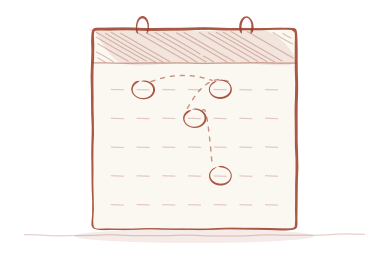
Say you finish a book on habits at the start of March and keep seven passages from it. A week later, on a Sunday morning, you look at them again: before each one, you try to recall the idea, then you read it. Most come back easily; one doesn't, and you add a short note to it.
At the beginning of May you meet them a second time. This time two have faded, and rereading them brings the whole chapter back. In the autumn, the third round takes five minutes, and the book now feels like something you know rather than something you once read. Total effort over a year: perhaps twenty minutes.
How many passages, how often
Fewer than you think. Three to five passages at a time, once or twice a week, is plenty for most readers, and small enough to keep up for years. Old highlights deserve priority: the ones from books you read long ago are the ones most likely to have faded, and the ones that surprise you most.
For more on why this works, and what else helps, see how to remember what you read.
Let it run on its own
The hardest part of any review routine is remembering to do it. A recurring reminder in your calendar works. So does a tool that brings the passages to you, so the only thing left to do is read.